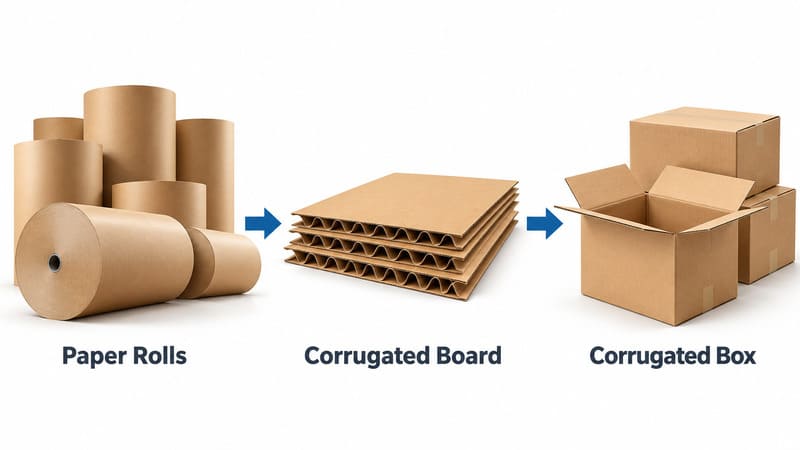
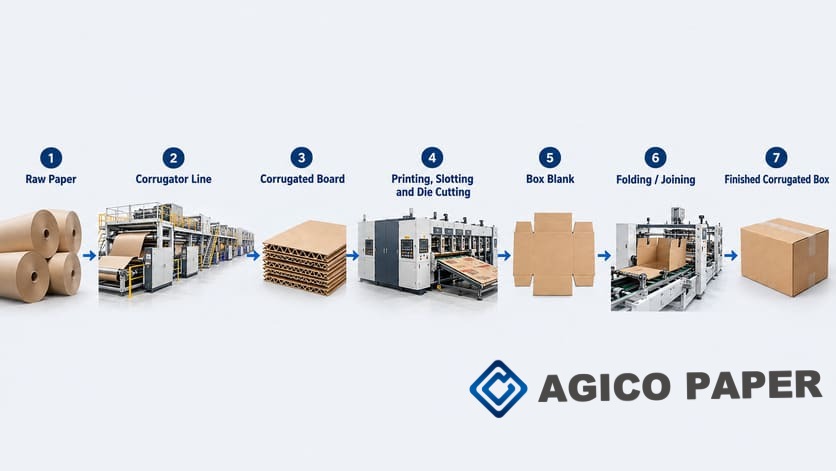
How are corrugated cardboard boxes formed? Linerboard and corrugating medium enter the corrugated board production line as paper rolls. The line processes them through corrugating, gluing, laminating, and slitting to form corrugated board. The corrugated board then enters the flexo printer slotter die cutter machine. The board is printed, creased, slotted, and die-cut to produce the box blank. Finally, the box blank passes through the corrugated folder gluer machine for folding and gluing. From raw paper to corrugated board to corrugated box. Corrugated board production is the front-end stage of the entire carton manufacturing process.
Scroll to see the full diagram →
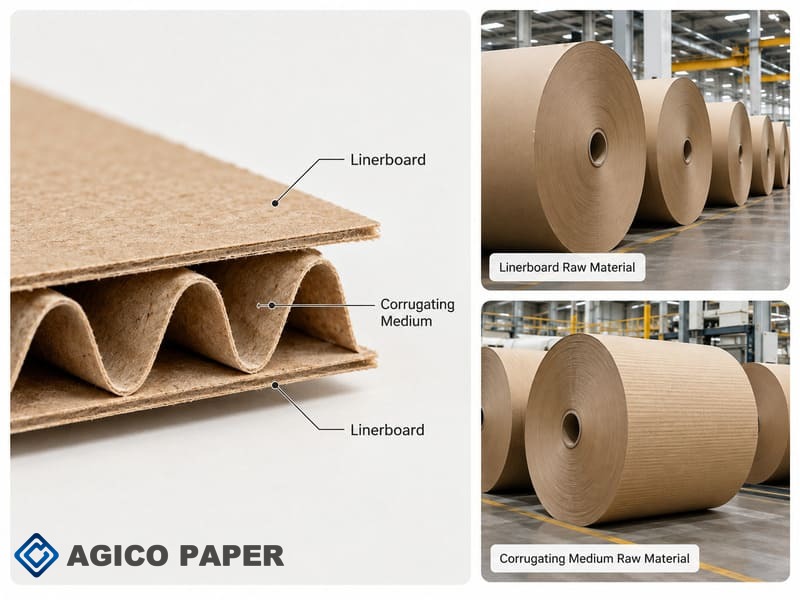
To understand how corrugated board is produced, we need to understand its materials. The board is made of linerboard and corrugating medium. Linerboard forms the outer and inner layers of corrugated board. It can improve the board’s strength and provide a flat surface. It is also the main printing surface for carton printing. Depending on the raw materials used and the production methods, linerboard can be of different types, such as kraftliner and testliner. The corrugating medium is located in the inner layer of the board. It forms the corrugated structure. This corrugated structure offers support and buffering for the board.
Scroll to see the full diagram →
How Is Corrugated Board Made from Paper Rolls?
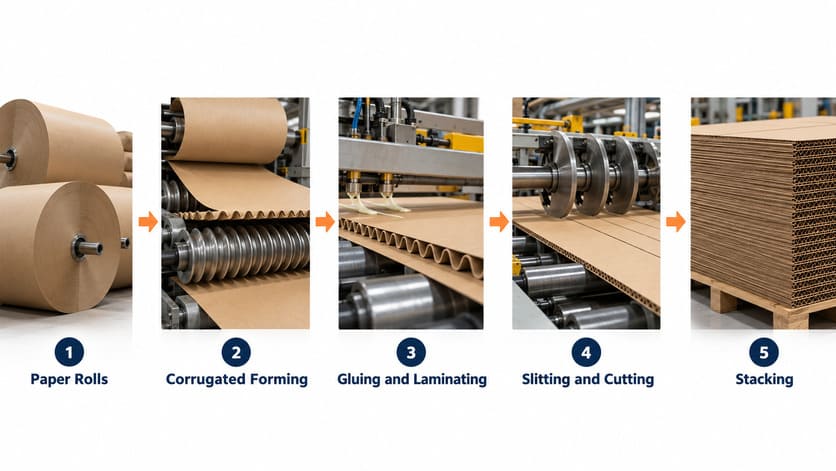
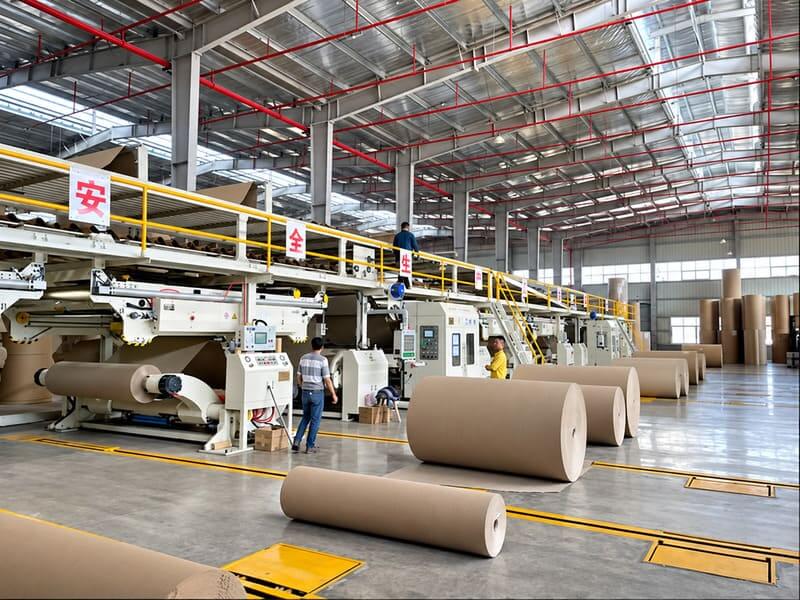
A corrugated board production line processes paper rolls into corrugated board. Paper rolls enter the line and go through corrugating, gluing, laminating, and sizing. Finally, the board is cut to the required size.
Scroll to see the full diagram →
Corrugated Forming
The paper roll is first preheated. The corrugating medium then enters the single facer, where the corrugating rolls form it into flutes. Adhesive is applied to the flute tips, and the fluted medium is bonded to a layer of linerboard. This forms single-face corrugated board.
Gluing and Laminating
The single-face corrugated board is conveyed through the corrugated bridge. It is bonded with other layers of linerboard or single-face corrugated board.
The double backer heats and presses the paper layers together to form complete corrugated board.
Corrugated Sizing
The continuous corrugated board enters the thin-blade slitter-scorer. It is trimmed, slit longitudinally, and scored. The board then enters the cut-off machine. It is cut to the required length and formed into individual sheets.
The finished sheets are arranged and stacked by the corrugated stacker before entering the next corrugated box-making process.
Different Types of Corrugated Board Production Lines
Corrugator lines can be classified by the number of board layers, production speed, working width, and flute type.
Scroll to see the full diagram →
Scroll to see the full diagram →
Board Layer
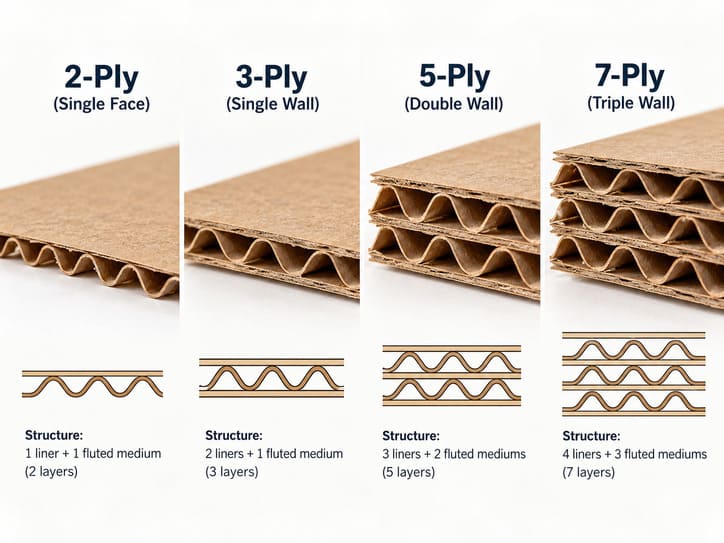
Corrugator lines are divided into 2-ply, 3-ply, 5-ply, and 7-ply lines based on the number of board layers. The 2-ply corrugator line mainly produces the single-face corrugated board. The 3-ply corrugator line produces the single-wall corrugated board. The 5-ply corrugator line produces the double-wall corrugated board. The 7-ply corrugator line produces the triple-wall corrugated board.
Production Speed
Production speed is another factor that affects the production capacity of a corrugator line. A higher speed means more corrugated board can be produced in a given time.
Working Width
Working width determines the paper width that the production line can process. Different working widths can meet the production needs of different board sizes. The actual working width varies depending on the line model and configuration.
Flute Type
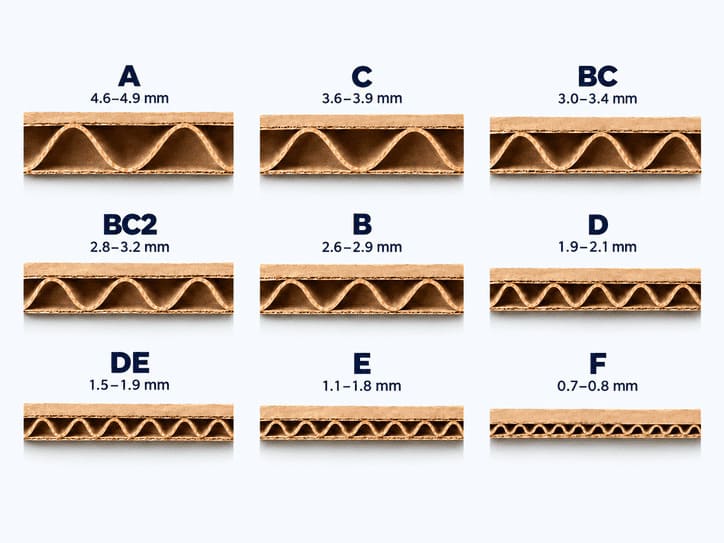
Different flute types have different flute heights and structures. A corrugated cardboard production line can be equipped with corresponding corrugating rolls according to the required flute type.
Flute Type
Flutes (flutes/300 mm)
Flute Height (mm)
A
34±2
4.6–4.9
C
38±2 / 40±2
3.6–3.9
BC
44±2
3.0–3.4
BC2
48±2
2.8–3.2
B
50±2
2.6–2.9
D
66±3
1.9–2.1
DE
75±4
1.5–1.9
E
96±4
1.1–1.8
F
124±10
0.7-0.8
Scroll to see all columns →
Note: The above parameters are for reference only. We can provide the right flute type and corrugating rolls for your production needs.
Investment Cost of Corrugated Production Lines
The cost of a corrugated board production line is not only the equipment price. The raw paper, electricity, labor, and machine maintenance also affect the long-term production cost. Different production speeds, working widths, and automation configurations can also affect the initial investment and running costs of the production line.
Cost
Main Factors
Equipment Investment
Production speed, working width, and equipment configuration
Raw Paper Cost
Raw paper type, board structure, and paper usage
Electricity Cost
Equipment configuration and running time
Labor Cost
Automation level and staffing
Maintenance Cost
Equipment usage and daily maintenance
Scroll to see all columns →
Corrugator Line and Box Production
After corrugated board production, the board still needs to go through printing, slotting, die cutting, and forming. If you plan box production from raw paper, the corrugator line and the following box-making machines need to match.
If you already have box-making machines, the corrugated board production line should match their working size and production capacity. AGICO PAPER can provide a suitable line configuration based on your production needs and existing equipment.
The corrugated board production line turns raw paper into corrugated board. The board still needs further processing before it becomes a finished corrugated box.
Printing, Slotting and Die Cutting
The corrugated board is printed, creased, slotted, and die-cut according to the box design. After this process, it becomes a box blank.
Folding and Gluing
The box blank is folded and glued to form the finished box. A folder gluer or box stitching machine can be used for this process.
If you already have a corrugated board production line, you can add the required box-making machines according to your production needs. If you plan to produce finished boxes from raw paper, the corrugator line and the following machines need to be selected together.
The process can be simply understood as:
Scroll to see the full diagram →
Raw paper → Corrugator line → Corrugated board → Printing, slotting and die cutting → Box blank → Folding / joining → Finished corrugated box
Why Choose AGICO PAPER
Flexible Equipment Configuration
AGICO PAPER can provide the main equipment needed for a corrugated board production line. This makes equipment selection and line planning easier.
Match Production Needs
Different board requirements need different line configurations. AGICO PAPER can also provide a suitable line configuration based on the board you need to produce, working size, and planned production capacity.
Complete Equipment Support
In addition to corrugated board production equipment, AGICO PAPER can also provide downstream corrugated box-making machines. When planning a corrugated board production line, you can also consider printing, die cutting, and folder gluing. This helps the equipment work better together.
FAQ
1. What Equipment Is Included in a Corrugated Board Production Line?
A complete corrugated board production line usually includes a mill roll stand, preheater, single facer, gluing machine, double facer, slitter scorer, cut-off machine, and stacker. The equipment configuration varies depending on the production line.
2. When buying a corrugator line, what information do I need to provide?
If you have a box to produce, please provide the box type, flat size, and planned production capacity. If you know the corrugated board you need, please provide the board layers, size, flute type, and planned production capacity. AGICO PAPER can recommend a suitable corrugator line based on these requirements.
3. How to Choose a Corrugated Board Production Line?
You can choose the production line based on the common board sizes and planned production capacity. The working width should meet the required board size. The production speed should match your planned output.
4. Can the Corrugator Line Work with Existing Box-Making Equipment?
Yes. If you already have box-making equipment, the corrugator line can be configured based on its working range and production capacity.